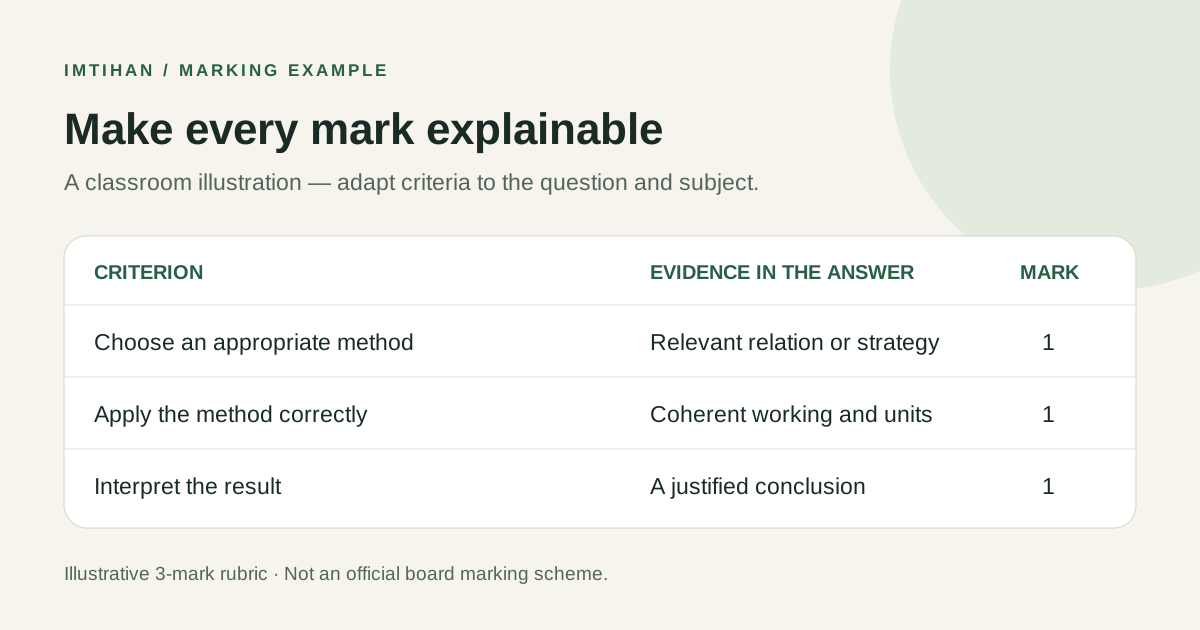
An IB mark scheme generator can draft worked answers and separate criteria for reasoning, method and final results. Imtihan provides a starting point for teacher review; it does not certify an answer key as IB-approved, and error-carried-forward treatment must be checked for the subject and question.
Why IB Mark Schemes Are Crucial
In the IB DP Chemistry and Physics syllabi, mark schemes are highly structured. They aren't just lists of numbers; they are rubrics that reward specific logical steps. A single question might assign separate marks for identifying a formula, substituting values, using correct state symbols, and writing the final value with appropriate significant figures.
When teachers write tests, compiling these criteria manually takes an enormous amount of effort. If a question is slightly modified — a different mass, a different angle, a different reagent — the entire calculation chain, and every mark tied to it, has to be reworked by hand, one line at a time.
The IB's own guidance on assessment describes command terms as signalling the expected depth of a response, and notes that the authoritative glossary for each is defined inside the relevant Diploma Programme subject guide rather than in one document covering every subject (IB Diploma Programme assessment). That's exactly why a mark scheme has to track which command term a question actually used, not just assign a flat point value.
Grading Secret
“Do not apply error carried forward as a blanket rule. Check the current subject guide and question-specific mark scheme, then document which criteria allow follow-through credit.”
Drafting and Reviewing IB-Style Mark Schemes
Imtihan's built-in IB mark scheme generator automates this workflow. When you prompt the AI to generate a question, the platform simultaneously builds a matching correction grid.
For quantitative problems in Physics (like mechanics or quantum fields), the generator produces full calculations in LaTeX format, documenting every step from raw formula to final uncertainty bounds. Common command terms and the depth of response Imtihan expects for each include:
- Deduce — reach a conclusion from given information, showing the reasoning step, not just the result.
- Outline — give a brief account or summary, without extended justification.
- Explain — give a detailed account including reasons or causes.
- Annotate — add brief notes to a diagram or graph, identifying key features.
Get Started for Free
IB teachers can sign up on Imtihan and generate their first mock exam and mark scheme completely for free, no card required. After generation, you can edit individual questions, add custom prompts, and export the entire test and grading key to Microsoft Word or PDF for easy grading — or regenerate a single question without rebuilding the whole paper.
A practical example for your classroom
Adapt this teacher brief to your level and the chapters actually taught:
Draft an IB-style practice question with its worked solution. Allocate each mark to a distinct criterion. Identify acceptable alternative approaches and flag where I must check error-carried-forward treatment against the current subject guide.
Before giving the paper to students
Check the current IB subject guide and official specimen mark schemes. A generated rubric is a draft, not an IB-approved mark scheme; error-carried-forward rules are subject and question specific.
Create an exam draft to reviewFrequently Asked Questions
Does Imtihan's mark scheme use the exact wording IB examiners use?
Command terms are harmonized in meaning across Diploma Programme subjects, but the authoritative glossary for exact wording lives inside each subject's own guide. Imtihan generates mark schemes built around the same command-term logic (Deduce, Outline, Explain, Annotate, and others), which you should still check against your specific subject guide before a high-stakes exam.
What is Error Carried Forward (ECF) and why does it matter for grading fairness?
Error carried forward may allow credit for subsequent valid reasoning after an earlier error. Whether it applies, and which marks remain available, depends on the subject and question. Check the current subject guide and official specimen marking guidance before using it in a generated draft.
Can I edit the mark allocation after Imtihan generates it?
Yes. Every generated question and its mark scheme can be edited, regenerated, or adjusted for difficulty individually — the AI draft is a starting point, and the final allocation is always the teacher's call.